
Buffalo | Monticello | St. Michael | Albertville | Otsego | Delano | Annandale and surrounding Wright County communities
As October wraps up, the Wright County commercial real estate market remains active, but increasingly specific.
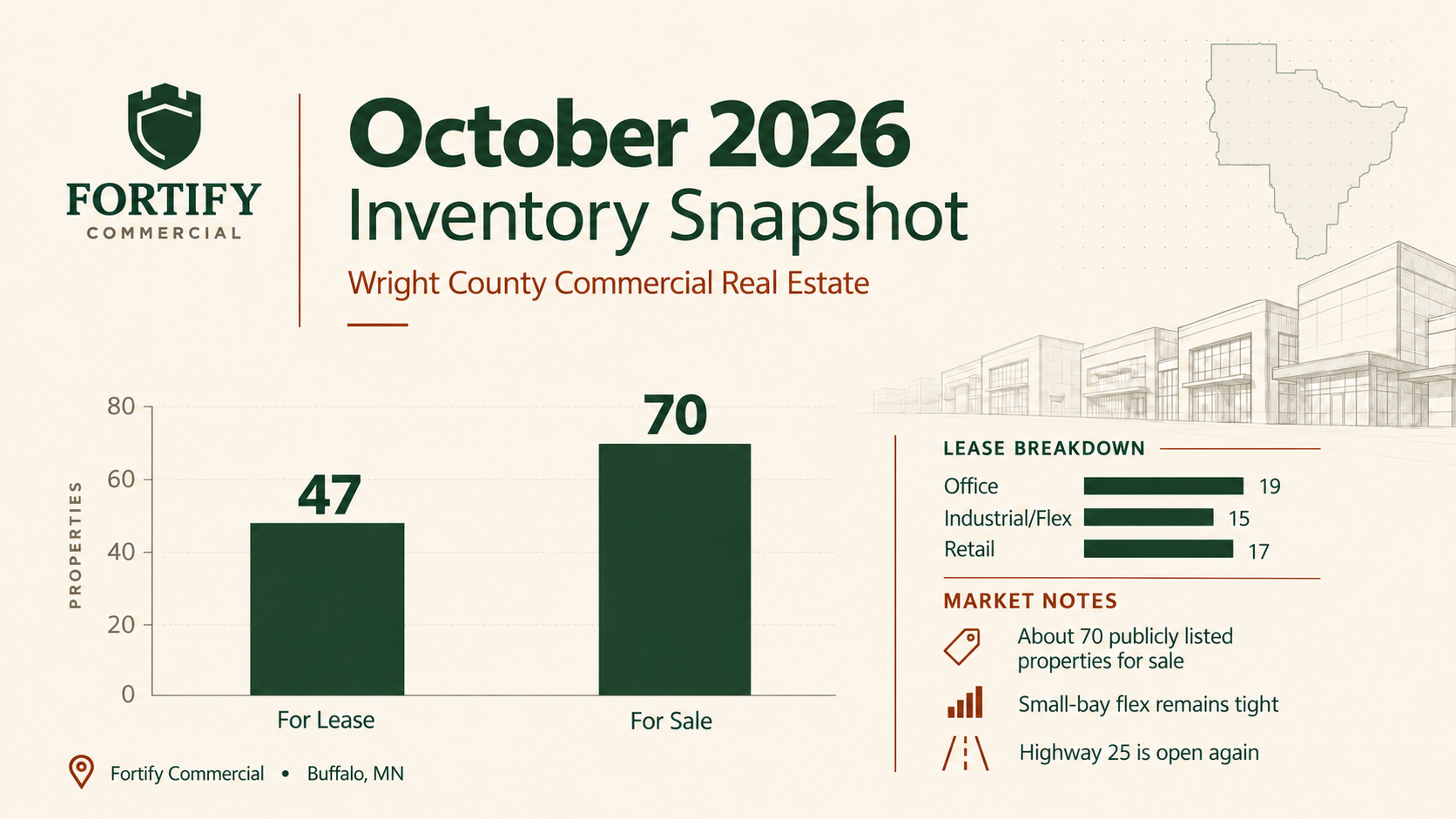
There are currently about 47 commercial properties publicly marketed for lease across Wright County and roughly 70 properties for sale. Those numbers have moved around slightly since September, but I would not describe the market as materially softer.
The bigger story is what happens once a tenant or buyer starts narrowing the search.
A contractor may need an overhead door, three-phase power and parking. A retailer needs visibility and easy customer access. A professional user may only need 1,500 square feet and does not want to pay for 4,000.
There may be dozens of properties available on paper. There are usually far fewer that actually fit.
That continues to define the Wright County market heading into the final part of 2026.
Where the Leasing Market Stands
Public lease inventory has stayed relatively stable over the last couple of months.
There are currently around 15 publicly marketed industrial and warehouse properties and 17 retail properties. Office inventory remains fairly broad as well, although many properties contain multiple suites and some listings overlap between office, retail and flex categories.
I would not put too much weight on the total number.
The more important distinction is between available space and usable space.
A professional office tenant can usually find several options.
A retailer willing to consider different cities and building ages has choices.
But a local contractor looking for 2,500 to 4,000 square feet with an overhead door, usable power and parking may get through the realistic options very quickly.
That is why I continue to look at each property type and size range as its own market rather than relying heavily on one countywide vacancy number.
Industrial and Flex: Small-Bay Space Is Still Hard to Replace
Industrial and flex continues to be one of the strongest parts of the Wright County leasing market.
The public inventory currently ranges from roughly 1,000-square-foot bays to 100,000-plus-square-foot warehouses and future industrial developments. Those properties technically fall into the same category, but they are serving completely different businesses.
For many local contractors, trades businesses and smaller manufacturers, the sweet spot remains around 1,500 to 5,000 square feet.
The typical wish list is fairly straightforward:
One or more overhead doors
Functional power
Some office space
Parking for employees and work vehicles
Convenient access to Highway 55, Highway 12, Highway 25 or I-94
Once those requirements are added, the market gets thin quickly.
Current asking rents also show how important size and functionality are. Publicly marketed examples include industrial space around $7 to $8/SF in Buffalo and Waverly, $10/SF in Delano, $12/SF in Monticello and $12.50/SF in Annandale. Smaller or more specialized space can push considerably higher.
There really is no single “Wright County industrial rent.”
A 37,000-square-foot warehouse and a 2,500-square-foot contractor shop are not competing for the same tenant.
For owners: if you have a clean small-bay industrial property with good doors, usable power and decent access, I would not immediately assume the rent is wrong because the building sits vacant for a few weeks.
Make sure the right businesses know it is available first.
Retail: The Building Still Has to Make Sense From the Road
Retail inventory has ticked slightly higher, with around 17 publicly marketed properties or spaces currently available across Wright County.
Pricing continues to vary widely.
Current public examples range from roughly $10 to $16/SF for older or secondary space, while newer Albertville and Monticello properties are around $23/SF. One highly visible Albertville property is currently marketed between $26 and $32/SF.
That spread makes sense.
A cheaper space is not necessarily the better deal if customers cannot see the business, parking is inconvenient or the entrance is difficult to find.
The retail spaces that tend to make the easiest case to tenants have:
Strong visibility
Clear signage opportunities
Easy parking
Simple customer access
A clean interior
A surrounding customer base that fits the business
Service-oriented users continue to be especially important in suburban retail. Medical and wellness, fitness, salons, childcare, professional services, food concepts and other businesses where the customer physically visits the location continue to make up a meaningful part of the tenant pool.
For an owner with older retail space, I would look at the property from across the street before automatically lowering the rent.
If the building does not make a good first impression, another dollar or two per square foot may not solve the real issue.
Highway 25 Is Open Again
One of the biggest changes this month has nothing to do with inventory.
The entire seven-mile Highway 25 corridor between Buffalo and south Monticello reopened to traffic on October 23 after seven months of construction.
The $11.4 million project restored and rebuilt the road surface, improved drainage and access points, added three roundabouts, and added pedestrian sidewalks and a shared-use trail.
For commercial property owners along the corridor, this matters.
Traffic patterns during much of 2026 were not normal.
If a retail or service property saw weaker activity during construction, I would be reluctant to treat that as permanent evidence that the location has weakened.
Now that the corridor is open again, the next several months should give owners a much better look at normal customer traffic and access.
If a space struggled through construction, I would refresh the marketing before making a major pricing adjustment.
Office: Smaller and More Flexible Still Wins
Office remains the segment where tenants generally have the most leverage.
The market is not dead. Businesses are still leasing office space.
What has changed is how much they want.
Local professional users are often looking for efficient, second-generation suites where they can move in without taking on more square footage than they actually need.
That might mean:
Three or four private offices
Reception
A conference room
A break area
Reasonable parking
A good 1,500 to 2,500-square-foot suite can have a much broader audience than a 5,000 or 6,000-square-foot traditional office.
For owners with larger vacancies, I would seriously consider whether the space can be divided before simply reducing the rent on the entire suite.
Sometimes the issue is not the rate.
It is the size of the product being offered.
The Sale Market: Slightly More Inventory, but Owner-User Buildings Are Still Limited
There are currently around 70 publicly marketed commercial properties for sale across Wright County.
That sounds like a lot of inventory until you look at what is actually included.
The market contains development land, industrial and flex condos, investment properties, downtown buildings, specialty properties and larger development opportunities.
That is different from having dozens of straightforward 3,000 to 10,000-square-foot freestanding buildings available for a local company to buy and occupy.
Those properties remain relatively difficult to replace.
The owner-user buyer continues to be important in Wright County.
A business owner may not evaluate a building like a traditional investor. They may care more about whether:
The building works for their operation
They have room to grow
Their monthly occupancy cost makes sense
They can control the property
They would rather build equity than continue paying rent
For sellers of smaller commercial buildings, I think the property should be marketed to both investors and owner-users.
Do not only show what the building earns.
Show how someone could actually operate a business there.
I-94 Is Nearing the Finish Line
The I-94 expansion between Albertville and Monticello is also entering its final stretch.
Construction of the third westbound lane is complete. Crews are finishing the eastbound side, and traffic is still generally operating with two lanes in each direction through the work zone at peak times.
MnDOT continues to target late fall 2026 for all six lanes to open, with some remaining cleanup work scheduled for 2027.
For commercial real estate, I view the long-term impact as much more important than the temporary inconvenience.
The completed project will improve freeway capacity and freight access through Albertville, St. Michael, Otsego and Monticello. MnDOT specifically identifies reduced bottlenecks, improved freight movement and support for future growth among the project's benefits.
That strengthens the corridor for industrial users, regional retailers and employers drawing workers from a larger area.
I expect I-94 to continue capturing a significant share of Wright County's larger commercial development.
Monticello Tech Took a Meaningful Step Forward
The proposed Monticello Tech development also advanced during October.
The proposal calls for an approximately 3 million-square-foot technology and data center campus on roughly 550 acres south of 85th Street and east of Highway 25.
On October 6, the Monticello Planning Commission held a public hearing and voted 4-1 to recommend approval of the conditional use permit, rezoning and preliminary plat applications.
The project is not approved.
The city's current project timeline lists a November 9 City Council public hearing and consideration of the applications, with the city required to act by December 8.
That distinction matters.
I would not price nearby property today as though a 3 million-square-foot development is guaranteed to happen.
What has changed is that the proposal has moved another step through the approval process.
Regardless of the final outcome, I think it reinforces a broader trend in Monticello.
Available land, infrastructure and I-94 access are allowing the city to compete for projects at a scale that would have been unusual for Wright County not that long ago.
Buffalo: Getting Closer to Normal After a Disruptive Construction Season
Buffalo spent much of 2026 dealing with road and downtown construction.
With Highway 25 now fully reopened and this year's 1st Avenue construction moving toward completion, access is getting much closer to normal.
The broader downtown project is not completely finished. The city has said additional improvements to portions of 1st Street NE, or Wide Street, will continue in 2027 so that work can coordinate with redevelopment of the former Wright County Government Center.
The current downtown improvements are intended to create better pedestrian connections, adjust parking, improve streetscapes and create more flexible public spaces.
For downtown property owners, I think this is where the conversation gets more interesting.
For much of the summer, the biggest question was simply how customers were going to get to the building.
Going forward, owners can start looking at how their own property fits into the improved downtown environment.
New streets and sidewalks do not automatically increase rent.
But downtown commercial real estate is heavily influenced by what happens outside the front door.
Parking, signage, lighting, storefront condition and the ability to comfortably walk between businesses all matter.
For owners of older downtown buildings, this is a good time to look at relatively simple improvements while the public side of downtown is also being upgraded.
What Has Actually Changed Since September?
October did not bring a major shift in the underlying market, but several things are worth noting.
Public lease inventory remains relatively stable. There are about 47 properties publicly marketed for lease today.
Sale inventory is somewhat higher. There are roughly 70 publicly marketed commercial properties for sale.
Small industrial remains difficult to replace. There may be 15 industrial and warehouse properties listed publicly, but much of that inventory does not compete for the typical 2,000 to 5,000-square-foot user.
Retail tenants have choices. There are around 17 publicly marketed retail options, and building quality, visibility and access continue to separate the stronger properties from the rest.
Highway 25 is fully reopened. One of the biggest temporary disruptions between Buffalo and Monticello is finally gone.
I-94 is approaching completion. All six lanes remain targeted to open later this fall.
Monticello Tech advanced through Planning Commission. It is still not approved, but the proposal is moving through the process.
The underlying leasing market remains fairly consistent: good small industrial space is difficult to replace, office tenants have options, and retail properties need to make a strong case on visibility and functionality.
What I Would Be Thinking About as an Owner Heading Into Winter
If I owned small industrial or flex space, I would focus on exposure and tenant fit before discounting the rent.
If I owned retail along Highway 25, I would give the reopened corridor some time before deciding that this year's traffic represented the property's long-term performance.
If I owned office, I would look honestly at whether the available suite is the size today's tenants actually want.
If I were preparing to sell a smaller commercial building, I would make sure the marketing speaks to owner-users as well as investors.
And if a property has been sitting for several months, I would review the entire presentation before assuming price is the only issue.
Sometimes it is the asking rate.
Sometimes the photos are weak.
Sometimes the signage is unclear.
Sometimes the listing does not explain what the building actually does well.
And sometimes the property simply has not reached the businesses most likely to use it.
Final Thoughts
Wright County's commercial real estate market remains healthy heading into the final months of 2026, but countywide averages only tell part of the story.
Small industrial and flex continues to perform well.
Retail works when visibility, access and presentation make sense.
Office remains competitive, but smaller functional suites continue to find users.
And several of the infrastructure projects that disrupted the market this year are finally approaching completion.
The best-performing properties tend to solve a specific problem.
A contractor needs the right shop.
A retailer needs customers to see the building.
A professional user needs the right amount of space.
An owner-user needs a property that works for the business without stretching the balance sheet.
Those tenants and buyers are still in the market.
The challenge is matching them with the right property.
If you're trying to determine where your building fits in today's market, whether that means lease rate, sale price, improvements or finding the right tenant, feel free to reach out.
View Available Properties
Looking for commercial space in Wright County or the surrounding area?
Fortify Commercial maintains a current selection of properties for lease and sale, including office, retail, industrial, flex and owner-user opportunities.
View Available Commercial Properties
If you don't see the right fit, reach out. Some of the best local opportunities never make it to the public market, and direct owner outreach can uncover additional options.
Fortify Commercial
Commercial Real Estate in Wright County and Surrounding Areas
205 2nd Ave NE
Buffalo, MN 55313
info@fortifycommercial.com
763-200-1440